
What “Optimal” Means Here
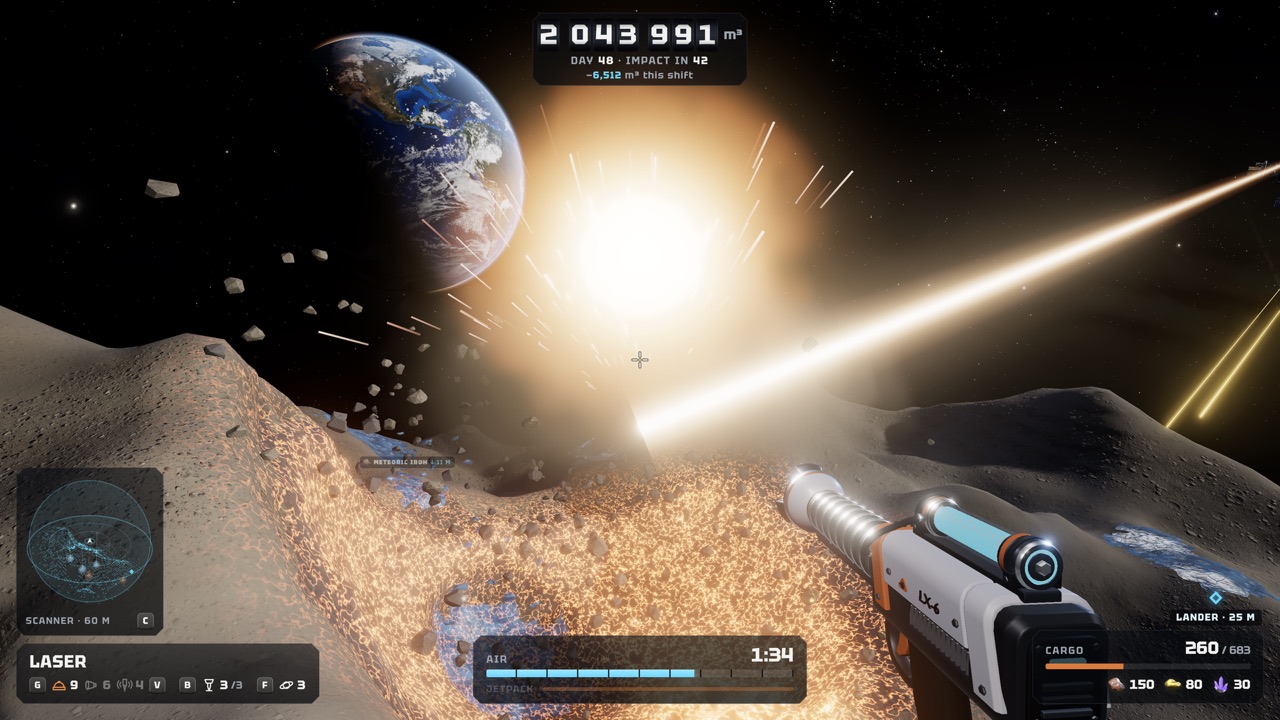
The goal is to clear 5,000,000 m³ of rock before day 90. A good run grows two numbers at once: ore income and rock removed per day. Income buys the tools and guns that remove more rock.
The developer says playtesters cleared the asteroid at very different speeds. Balance also changed several times before launch. So treat any day-by-day benchmark as a snapshot of one build.
Rule 1: Fix the Limit That Ends Your Shift
Every shift ends because of one limit: full cargo, empty air or too little time to dig. Players on Steam describe balancing cargo and oxygen against mining speed. Spend on the limit you hit first.
If cargo fills with air left, buy capacity. If air runs out with space left, buy more air. If you have both but mine slowly, buy a better tool.
Rule 2: Never Lose a Haul
Missing the lander costs your whole cargo, because you black out. Anyone in the lander can start the 10-second countdown. A lost haul is a full day of income gone.
Mine within easy reach of the lander early on, and watch the LANDER distance on the HUD. The tether helps you get back from deep shafts. See how to return to the lander.
Rule 3: Let the Ship Guns Work for You
Ship guns fire at the asteroid on their own while you dig. That makes them the main way to speed up rock removal. The first gun in the official price grid, the Turret, costs 1,250 credits.
Players disagree on when the first guns and drones pay off. Test it in your own run by comparing the counter before and after a purchase. Our ship gun prices page lists all nine guns and the slot costs.
The Tool Ladder
The Workshop lists six tools: pickaxe, sledgehammer, drill, laser, plasma cutter and missile swarm. In the prelaunch screenshot, the plasma cutter costs 125,000 and the missile swarm 600,000 credits. Players report very different laser and plasma cutter timings.
The missile swarm gained a tunnel mode on November 21. Right-click switches between spread fire and a focused salvo that digs deeper. Your chosen mode is saved between sessions.
Use Charges and Drones
The Workshop also sells charges and drones. Since November 21, you carry 12 standard charges by default and up to 24 with upgrades. Blast-radius upgrades are also more powerful.
Drones include the Digger, Prospector and Sapper. Digger and Prospector power upgrades grant 25% per level, and the Digger now seeks nearby rock on its own. See mining drones in co-op for more.
Watch the Last Few Percent
Steam’s user tags for the game include Multiple Endings. One creator, OutbackBiff, removed 99.9% of the asteroid in a November 13 episode, and the title says one rock still hit Earth. Keep an eye on the counter late in the contract.
Mining detached rock counts toward layer-mining objectives since November 21. Big pieces break off and float away, and you can ride them. Do not ignore loose rock near the end.
Measure and Compare Runs
Record your difficulty, build date and crew size before comparing two runs. The November 21 patch changed Hard mode, co-op income and tool prices for crews. A route from an earlier patch may not match the current economy.
Track credits earned and rock removed per in-game day. That shows which purchase sped your run up the most. A full no-commentary campaign by stenwick on November 12 is one public route reference.
Sell Smart at the Terminal
Ore prices change from day to day. The official trade terminal screenshot lists Space ice, Meteoric iron, Star gold, Space crystal and Plasmite, each with today’s price. Some prices show a daily rise, such as Star gold up 22% in that screenshot.
The same terminal sells skills. Refining raises ore price, and Buyers raises demand for ore. Both make every later haul worth more, so they fit an efficient run.
Make Every Shift Count
Wasted landings cost a full day. The November 21 patch added a confirmation when you return immediately from a solo landing without mining or collecting cargo. That protects you from a misclick.
Keep your combo going while you mine. Since November 20, it shows an ore icon and a multiplier on screen. Mining detached rock also counts toward layer-mining objectives.
Solo vs. Co-op Runs
Solo and co-op runs use different economies. Since November 21, ore sales pay 90% of normal value after multiplayer shifts. Laser, plasma cutter and missile swarm prices rise 50% for two players and 100% for three or more.
A crew digs more rock per shift, but each tool costs more and each haul pays less. Compare co-op runs only with other co-op runs of the same crew size. Our co-op guide explains the shared wallet.
Wash the Lander Every Day
Players report that washing the lander gives cargo and ore sale bonuses. It costs nothing but a little time between shifts. The wash hose reaches 25 metres since November 21.
Exact bonus values are unconfirmed, so do not plan a route around them. Treat it as a free daily extra. See lander washing bonus.
Frequently Asked Questions
Does difficulty affect an optimal run?
Yes. New Hard campaigns have about 25% less ore, 90% ore income and 50% pricier ship guns.
Is there a known fastest route?
No verified fastest route exists. The developer says playtesters finished at widely different speeds, and balance changed before launch.
Should I play solo or co-op for an optimal run?
Compare like with like. Co-op shifts pay 90% of normal ore value and later tools cost more for crews since November 21.
When should I buy ship guns?
As soon as income supports them. They remove rock on their own while you dig, so they speed up the counter.
Official Video
Sources and Further Reading
- Steam · No Asteroids store page (app 5527800)
- Unruled Games · No Asteroids game page and press kit
- Steam discussion · Upgrade Approach and Sequence
- Steam discussion · Progression and Resource Balance
- Unruled Games · Save Slots, Hard Mode & Co-op Improvements (Nov 20)
- Unruled Games · Stronger Drones, Tunnel Mode & Co-op Fixes (Nov 21)
- Unruled Games · Official Workshop screenshot
- Unruled Games · Official Engineering screenshot (GUNS tab)
- YouTube · stenwick, full playthrough and ending (Nov 12)
- YouTube · OutbackBiff, 99.9% asteroid removal (Nov 13)