
Two Numbers Decide the Contract
You have 90 days to clear 5,000,000 m³. Your wallet funds upgrades, and the counter shows how much rock is left. A good strategy keeps both moving in the right direction.
Early on, ore income matters most, because you have little to spend. Later, rock removed per day matters most, because the deadline approaches. The shift between these two goals is the heart of the game.
Early Game: Build Income Safely
Start with the pickaxe and mine close to the lander. Bring every haul back, because missing the lander means a blackout and lost cargo. One lost shift sets your income back a full day.
Ore prices change daily at the trade terminal. An official screenshot shows Space ice, Meteoric iron, Star gold, Space crystal and Plasmite, each with its own price. Terminal skills such as Refining and Buyers raise ore price and demand.
Mid Game: Better Tools
Buy a better tool when you have time and cargo space but mine too slowly. The Workshop ladder runs from pickaxe to sledgehammer, drill, laser, plasma cutter and missile swarm. Players report different orders, such as a hammer first or saving for the drill.
Charges help clear big areas fast. Since November 21, you carry 12 standard charges by default and up to 24 with upgrades. Blast-radius upgrades also got stronger.
Scale Up With Ship Guns
Ship guns fire at the asteroid on their own while you dig. That is how the counter falls faster than you could dig alone. The developer’s trailers describe this as the main way progress speeds up.
The official price grid starts at 1,250 credits for the Turret and ends at 1,200,000 for the Collapsar. A creator reports paying 1.2 million for the black-hole weapon, matching the Collapsar price. Plan your spending with our ship gun prices page.
Put Drones to Work
The Workshop sells drones alongside tools and charges. Patch notes name the Digger, Prospector and Sapper. The Digger excavates larger areas and seeks nearby rock on its own.
The Prospector keeps working when your backpack is full, as long as the ship’s hold has room. Players disagree on when drones pay off. Compare the counter before and after you buy one.
Co-op Strategy
In co-op, the ore money goes into one wallet, and the host decides who can spend it. Agree on major purchases before anyone buys. A tool bought for the crew can be used by everyone.
Since November 21, ore sales pay 90% of normal value after multiplayer shifts. Laser, plasma cutter and missile swarm prices rise 50% for two players and 100% for three or more. Wait for everyone to board before the 10-second lander countdown.
Late Game: Finish the Rock
Near the end, every remaining cubic metre counts. Big pieces break off and float away, and mining detached rock counts toward layer-mining objectives. Clean up loose rock as well as the core.
One creator removed 99.9% of the asteroid and still saw a rock hit Earth, according to the video title. Steam’s user tags include Multiple Endings. Keep pushing the counter down until the last day.
Adjust for Hard Mode
The hard way changes the economy. New Hard campaigns have roughly 25% less ore, 90% of normal ore income and 50% higher ship gun prices. Existing Hard saves keep their old rules.
On Hard, every haul matters more and guns take longer to afford. Lean on safe returns and efficient tool upgrades. Read our hard mode differences page before starting.
Read the Market Every Day
The trade terminal shows each ore’s stock and today’s price. In the official screenshot, prices range from a few credits for Space ice to more for Space crystal and Plasmite. Some prices show a daily rise, so check before you sell.
Antimatter is worth more than it used to be. The November 20 patch raised its base sale price from $56 to $150. If you find some, it adds real value to a haul.
Use Your Time on the Ship
Between shifts, the ship has more than shops. Players report daily bonuses for washing the lander, including more cargo and better ore prices. The wash hose now reaches 25 metres.
Items you find in the rock go to the ship’s museum, such as an empty safe labeled “Asteroid defense budget.” The telescope in the observation dome shows Earth, where a crowd holds KEEP WORKING signs. See lander washing bonus.
Common Strategy Mistakes
Most failed runs share a few mistakes. Watch out for these:
- Losing hauls by missing the lander.
- Delaying ship guns too long, so the counter falls slowly.
- Buying a tool when cargo or air is the real limit.
- In co-op, spending from the shared wallet without agreeing first.
Plan Around the Calendar
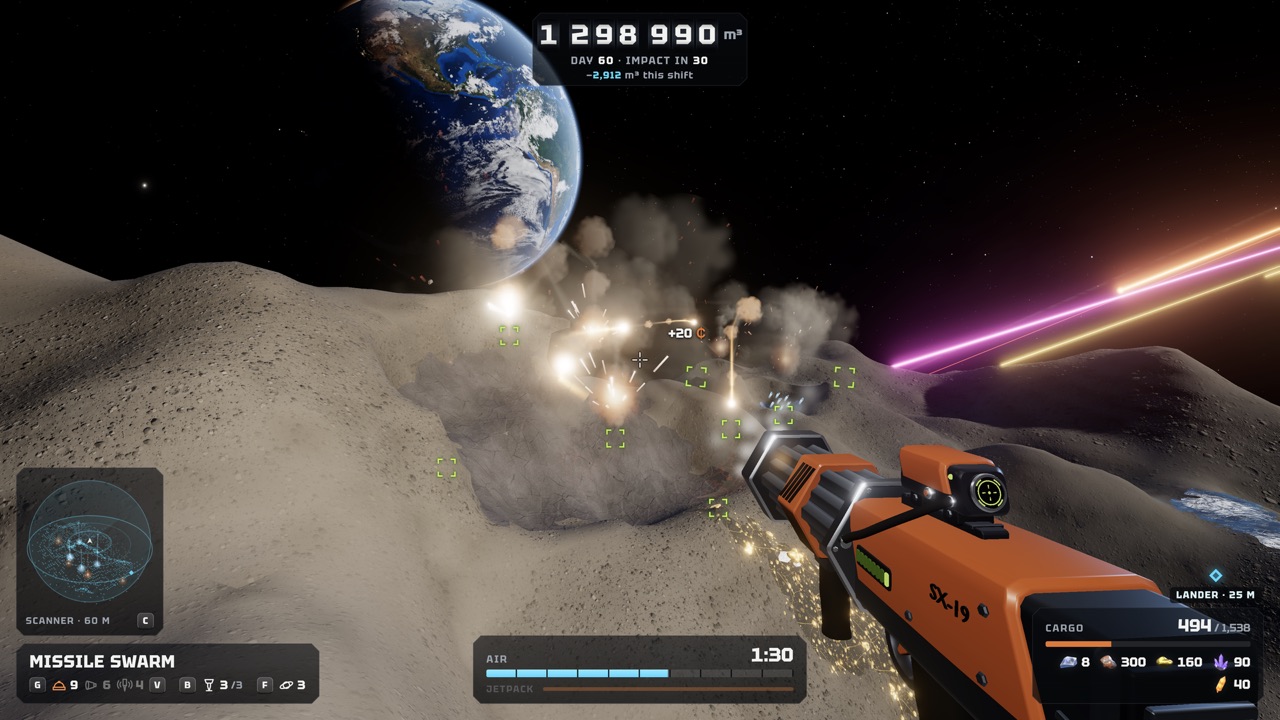
The counter at the top of the HUD shows the current day and the days until impact. In an official screenshot, it reads DAY 3 · IMPACT IN 87. Check it at the start of each shift.
Spread your goals across the 90 days. Use the early days for income, the middle for tools and guns, and the end for clearing what is left. The demo covers the first 20 days if you want to practice the opening.
Frequently Asked Questions
How long does a full run take?
Alone, the main contract takes about 6 to 9 hours, according to the developer.
What is the most important No Asteroids tip?
Never lose a haul. Missing the lander costs your cargo, and early income drives everything else.
Are ship guns worth it?
Yes. They fire at the asteroid on their own while you dig, which is how the counter drops faster.
How should a co-op crew spend money?
Agree on big purchases. The ore money goes into one wallet, and the host decides who can spend it.
Official Video
Sources and Further Reading
- Steam · No Asteroids store page (app 5527800)
- Unruled Games · No Asteroids game page and press kit
- Steam discussion · Upgrade Approach and Sequence
- Unruled Games · Save Slots, Hard Mode & Co-op Improvements (Nov 20)
- Steam discussion · Enjoying the daily buffs
- Unruled Games · Stronger Drones, Tunnel Mode & Co-op Fixes (Nov 21)
- Unruled Games · Demo co-op and 20 playable days (Nov 13)
- Unruled Games · Official Engineering screenshot (GUNS tab)
- Unruled Games · Official Workshop screenshot
- YouTube · Sonoket Gaming, No Asteroids Part 1 (Nov 20)
- YouTube · OutbackBiff, $1.2 Million Black Hole Weapon (Nov 12)
- YouTube · OutbackBiff, 99.9% asteroid removal (Nov 13)